
Learn about and help solve a complex issue in Indonesia
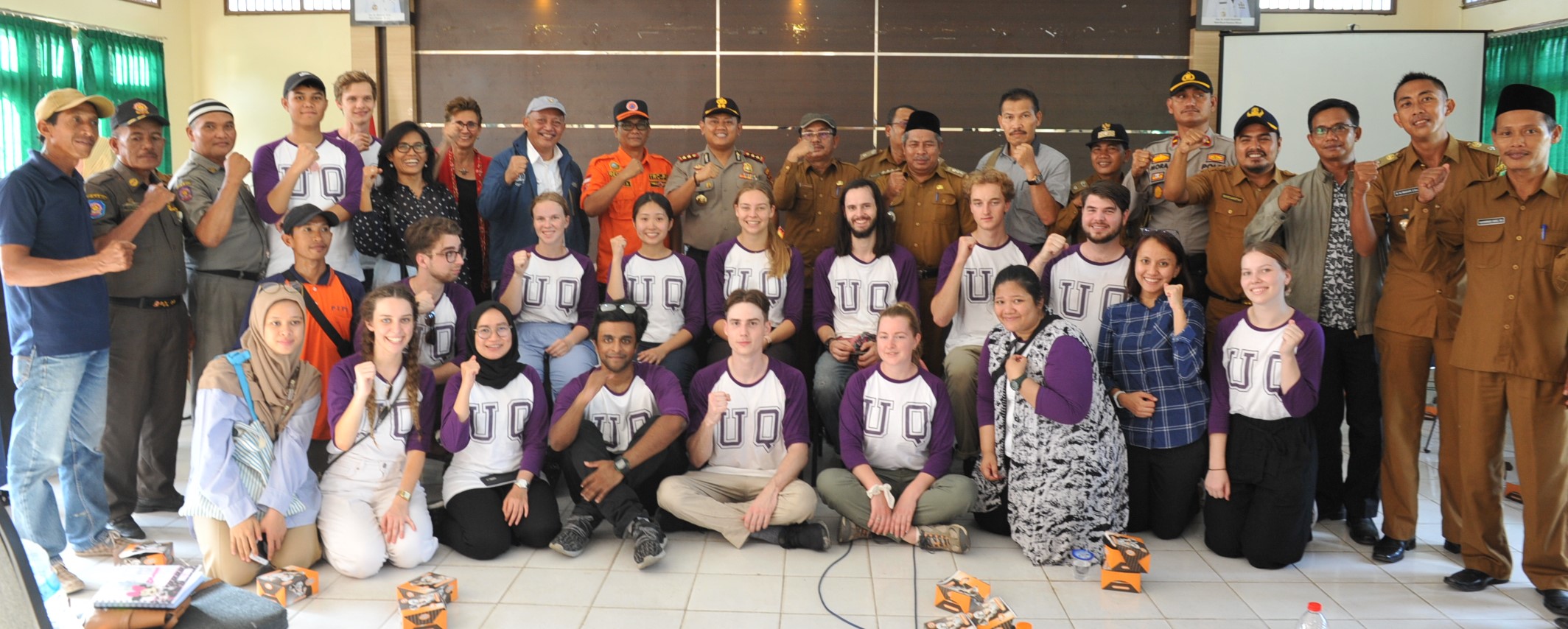
The UQ Communication and Social Change (CfCSC) group facilitates study trips for UQ undergraduate students. Students from a wide range of disciplines are offered the opportunity to explore a complex real-life issue in Indonesia in a hands-on way.
Hosted by various Indonesian partner organisations, students will spend 7 weeks in Indonesia, consisting of 4 weeks Indonesian language training at a local university and 3 weeks’ fieldwork in a specific region. The purpose of the fieldwork is to unravel policies and programs put in place to address the United Nations’ 2030 Agenda for Sustainable Development.
PEATLI stands for “People, Environment, And Transdisciplinary Learning – Indonesia”. In 2025/2026, the eighth cohort of the project, PEATLI-8, will be hosted by the Centre for Culture and Frontier Studies and the Faculty of Social and Political Sciences at Brawijaya University (UB) in Malang, East Java. The fieldwork will be done for and with the Regional Planning, Research and Development Agency of Trenggalek Regency, East Java. (In Indonesia, a regency is a governing body at the same administrative level as a city.)
During the fieldwork, UQ students work with UB students in teams of mixed disciplinary backgrounds. The teams will conduct a participatory situation analysis with stakeholders at the regency and community level. They will explore the policies and programs that target the Sustainable Development Goals (SDGs), especially those relating to poverty, equality and the environment. Teams will also learn from community members how these programs affect their families, and assess the effectiveness of engagement and empowerment processes designed for community-led sustainable and equitable development.
PEATLI-8 can accommodate up to 12 students in total. Students will be recruited, trained and mobilised according to this plan:
| Expression of interest and participant selection | Semester 1, 2026 |
| Preparatory workshops (15 hrs) at UQ St Lucia campus | Semester 2, 2026 |
| Travel in Indonesia | 4 Jan – 21 Feb 2027 |
| In-country introductory program, language training and fieldwork methodology development workshops (4 weeks) | Brawijaya University, Malang, East Java Province |
| Fieldwork involving consultation with local government departments and community members (2.5 weeks) | Trenggalek Regency, East Java Province |
| Seminar of fieldwork findings (0.5 week) | Brawijaya University, Malang, East Java Province |
There are 9 travel grants for UQ students. They are funded by the New Colombo Plan (NCP) Mobility Program and are available to participants who are:
- Australian citizens
- Enrolled in an undergraduate degree at UQ
- Able to get credit for PEATLI-8 towards their undergraduate program, through a course taken in the semester following travel to Indonesia.
In addition, 3 self-funding students are invited to participate. They can be of any nationality or from any study program, but must be enrolled at UQ both at the time of EOI submission and throughout the activities of PEATLI-8.
The PEATLI project is supported by a range of undergraduate programs under the HASS, Science, BEL and HABS faculties. Students should discuss with their Program Convenor how they can use the PEATLI experience for course credit. This can be through a practicum, internship or industry placement course, a research or special studies course, or a course with a piece of assessment that allows a report on the research and/or engagement work done in Indonesia.
Application
Please download and complete the PEATLI-8 Expression of Interest form (DOCX, 168KB). Email the completed application to the Project Leader by the due date indicated on the EoI form.
Additional information
Previous PEATLI cohorts visited the provinces of Central and West Kalimantan (PEATLI-1 and -3, respectively), Riau (PEATLI-2), Jambi (PEATLI-4), West Nusa Tenggara (PEATLI-5 and -6) and East Java (PEATLI-7). They were hosted by different organisations and spent a total of 2.5 weeks in-country. Some of their experiences are captured in the following stories:
Video by PEATLI-6 student (Jun-Jul 2024)
Video by PEATLI-5 student (Nov-Dec 2023)
Video by PEATLI-3 student (Nov-Dec 2022)
Video by PEATLI-2 student (Nov-Dec 2019)
Article on PEATLI-1 experiences (Jun-Jul 2019)
Questions?
For information about:
- The PEATLI project: Contact Associate Professor Elske van de Fliert, Director, Centre for Communication and Social Change and PEATLI Project Leader
- NCP funding: Contact Ms Katie Smith, Sponsored Mobility Project Officer
- UQ travel arrangements and insurance: Contact Mr Sven Fea, Placement Officer, School of Communication and Arts
- UQ’s connection with Indonesia: See the Global Partnerships “UQ and Indonesia” website